Interiors
10 Interior Design Styles and What Defines Each One
Scandinavian, Japandi, wabi-sabi, mid-century modern, biophilic, brutalist and more: the palette, materials and signature pieces behind 10 interior design styles.
The Swiss shelving system in every design editor's apartment is a modern classic for a reason. Here is what makes it so good — and twelve modular pieces that capture the same build-it-your-way magic.
'%2F%3E%3C%2Fsvg%3E) By Julius ·June 2026 ·5 min read
By Julius ·June 2026 ·5 min read 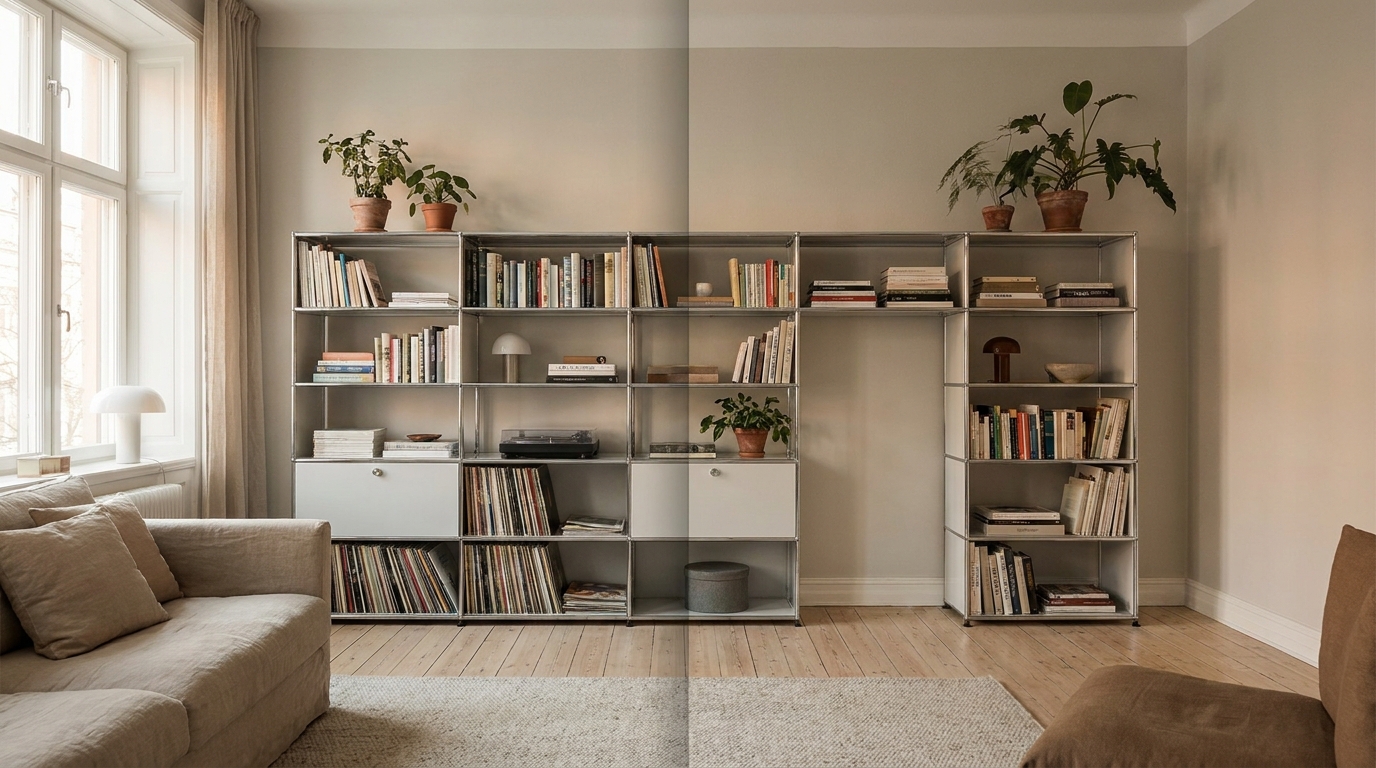
You have seen it: a crisp grid of chrome tubes and glossy, candy-colored steel panels, holding books and records like it was born to. That is USM Haller, the 1960s Swiss system that has quietly become one of the most coveted pieces of furniture you can buy — in MoMA's permanent collection, handed down between generations, sold out whenever a streetwear label collaborates on it.
If you are here, you probably already love it and want to know what else scratches the same itch. Below, why USM earns its cult status — then twelve modular pieces that deliver the same magic, at almost every price point.
The whole system comes down to one part: a chrome-plated ball with six threaded holes. Steel tubes screw in from any direction and powder-coated panels close it off — so from ball, tube and panel you can build a credenza, a bookshelf, a desk, then rebuild it later.
'%2F%3E%3C%2Fsvg%3E)
Best for the metal grid, without the USM price.
Ronan & Erwan Bouroullec's Pier pairs aluminum and powder-coated steel in a clean, lightweight grid — shelves and cabinets that mix, match and move as your needs change.
'%2F%3E%3C%2Fsvg%3E)
Best for modular, scalable storage in warm oak, not steel.
A warmer, quieter take on the USM idea: oak veneer across a range of sizes, the same build-to-your-space logic softened by Japandi calm.
'%2F%3E%3C%2Fsvg%3E)
Best for expandable storage at a low entry point.
The other great modular icon. Designed in 1949, its wire side panels and simple shelves were the original expandable shelf — lighter and warmer than USM, and you can start with one.
'%2F%3E%3C%2Fsvg%3E)
Best for total color, in warm lacquered wood.
If color is your favorite thing about USM, this is the match — a Danish lacquered cube system in dozens of shades, on the wall, on legs, or on castors.
'%2F%3E%3C%2Fsvg%3E)
Best for colorful, reconfigurable storage that starts small.
The playful Scandinavian take: mix open and closed cubes, add color, and build anything from a bookshelf to a room divider, a few modules at a time.
'%2F%3E%3C%2Fsvg%3E)
Best for an iconic, affordable modular piece with personality.
Anna Castelli Ferrieri's 1967 stackable, glossy round column has been in production — and in MoMA — for decades, in a rainbow of finishes.
'%2F%3E%3C%2Fsvg%3E)
Best for Rams-level restraint and an heirloom wall system.
Dieter Rams's 1960 wall-mounted E-track lets shelves hang and rearrange without tools — airier and more restrained than USM, on a buy-less-add-later philosophy.
'%2F%3E%3C%2Fsvg%3E)
Best for the steel-and-color look on a budget.
A whole category of modular metal cube shelving delivers USM's flip-it-vertical-or-horizontal flexibility for a fraction of the price, tool-free and in many colors.
'%2F%3E%3C%2Fsvg%3E)
Best for the open metal-grid aesthetic, affordably.
For the grid look without the design-house price, open-grid steel bookcases capture the airy, geometric feel — often expandable and stackable, black through wood-and-steel.
'%2F%3E%3C%2Fsvg%3E)
Best for modular flexibility in warm, natural wood.
Prefer warm wood to steel? Modular wood systems bring the grows-with-you idea into ash, oak and walnut, at an accessible price.
'%2F%3E%3C%2Fsvg%3E)
Best for the low-credenza record look, for less.
One of USM's most-loved uses is the low credenza for records. Low-profile units sized for vinyl and AV gear capture it — many doubling as room dividers.
'%2F%3E%3C%2Fsvg%3E)
Best for a mid-century wall system with real pedigree.
Poul Cadovius's 1948 design — a decade before USM. Wood shelves and cabinets hang from slim wall rails on elegant brackets, configurable in countless ways, in walnut or oak.
The thing that makes USM so beloved — furniture that adapts to you — is available at almost any price point. Want the dream itself? Buy USM with confidence. Want the metal-grid look for less? HAY Pier. Prefer warm wood to steel? Ferm Living's Kona. Obsessed with color? Montana. Shopping smart? Wayfair's cube and open-grid systems. Pure minimalism? Vitsœ.
Prices and availability may change after publication. Some links on this page are affiliate links — if you buy through them we may earn a commission, at no cost to you.
USM began as a Swiss metalworking shop in 1885. The furniture arrived in the 1960s, when company head Paul Schärer commissioned architect Fritz Haller to design a new headquarters; the two ended up designing matching modular steel furniture to fill it. It entered series production in 1969 and joined MoMA in 2001.
It is made to order in Switzerland from chromed steel and powder-coated panels, engineered to last for decades, around a patented connector that lets it be reconfigured indefinitely. Parts made today still fit units from fifty years ago.
Unusually well. Well-maintained pieces commonly resell for a large share of their original price, which is why owners treat it more like a design asset than a disposable purchase.
Modular powder-coated steel cube systems and open-grid metal bookcases capture the steel-and-color, reconfigurable feel for a fraction of the price. For an iconic-but-affordable option, the Kartell Componibili is a fun place to start.