The desk we replaced this winter had lasted three years, which is roughly the warranty and exactly the point. It was engineered to be adequate and then, quietly, to be gone. We wanted the opposite: a room assembled slowly, from things that would still be here — scuffed, oiled, a little darker — when the work that fills it has changed twice over.
So we set a rule. Nothing enters the room unless we can picture it in ten years. It sounds austere. In practice it is the most forgiving rule we know, because it rejects almost everything on your behalf and leaves you with a very short, very good list.
“A good desk should outlive the job that bought it.”
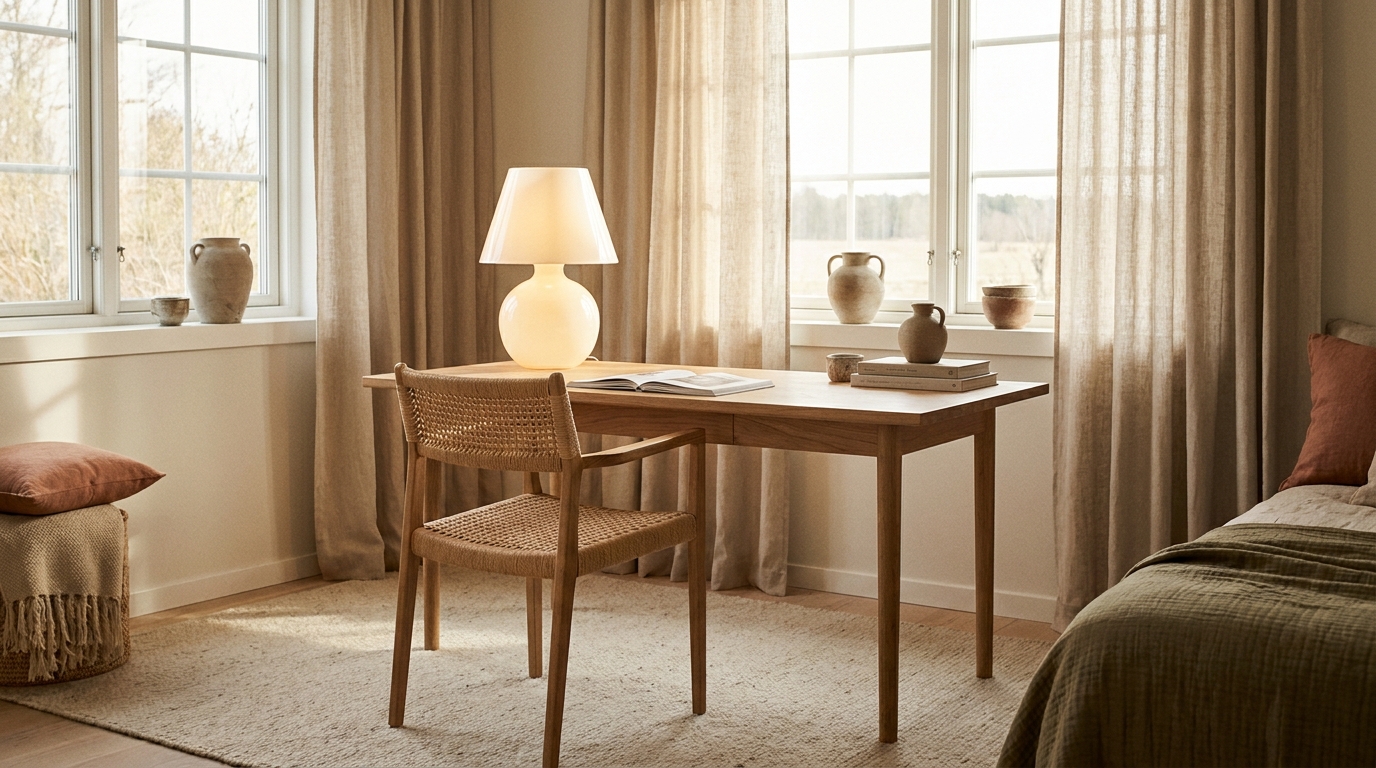
We began where the hours are spent. A writing desk in solid oak, wide enough for a laptop and a notebook open side by side, with a shallow channel routed along the back edge so the cables never announce themselves. It is heavier than it needs to be, and we have come to read that weight as a promise.
'%2F%3E%3C%2Fsvg%3E)
A desk this plain asks for very little around it. That is its second gift: it sets the register for the room, and everything after has to earn its place beside it.
The overhead fitting we inherited flattened everything it touched. We turned it off for good and put a single lamp on the desk — layered opaline shades that hide the bulb entirely and throw a soft, low pool of light across the page. In the afternoon it is the only thing on; the rest of the room dims into it.
'%2F%3E%3C%2Fsvg%3E)
We tried, and returned, three task chairs — all mesh, all levers, all promising to correct us. In the end we chose a chair with a papercord seat and a soap-finished oak frame that has been made, more or less unchanged, since 1950. It does not adjust. It simply fits, and it asks you to sit like a person rather than a diagram.
The morning it arrived, the room finally read as finished — not decorated, finished. Below, a few frames from that first quiet week of using it.
'%2F%3E%3C%2Fsvg%3E)
'%2F%3E%3C%2Fsvg%3E)
'%2F%3E%3C%2Fsvg%3E)
'%2F%3E%3C%2Fsvg%3E)
'%2F%3E%3C%2Fsvg%3E)
'%2F%3E%3C%2Fsvg%3E)